
 English
 Español
 عربى
عربى Türk
Türk
Loop yarn is a kind of fancy yarn, generally composed of core yarn, pressure yarn (sometimes also ca...

 2026.03.27
 Industry News
Novelty yarns — also called fancy yarns in the textile industry — occupy a distinct category in yarn engineering where the primary design objective is visual and tactile interest rather than uniformity. Unlike standard spun or filament yarns optimized for consistent tensile strength and smooth surface, novelty yarns are deliberately constructed with irregularities: loops, slubs, knots, twists, color variations, and textural contrasts that translate into fabrics with dimensional, decorative, and functional properties unavailable from conventional yarn types. Understanding how novelty yarns are classified and what structural advantages each type offers helps textile designers, fabric developers, and apparel buyers make more targeted material choices.
Most novelty yarns are produced by manipulating the relationship between two or more component yarns during the spinning or twisting process. The standard construction involves three functional elements: a core yarn that provides tensile strength and dimensional stability, an effect yarn that creates the decorative feature — loops, slubs, boucles, or other irregularities — and a binder yarn that locks the effect yarn in position relative to the core. The ratio of feed speeds between these components, the degree of twist applied, and the points at which the effect yarn is periodically overfed or restrained determine the character and regularity of the resulting novelty structure.
Not all novelty yarns follow this three-component model. Slub yarns, for example, are created during the drafting stage of ring spinning by intentionally varying the attenuation of the roving to produce thick and thin sections in a single continuous yarn. Chenille yarns are constructed through a fundamentally different process — pile fibers are cut and trapped between two twisted core yarns — producing a yarn with a velvety pile surface rather than a structural irregularity. Understanding the construction method of a given novelty yarn type is essential because it determines the yarn's processability on weaving and knitting equipment, its behavior in fabric, and its durability under use and laundering.
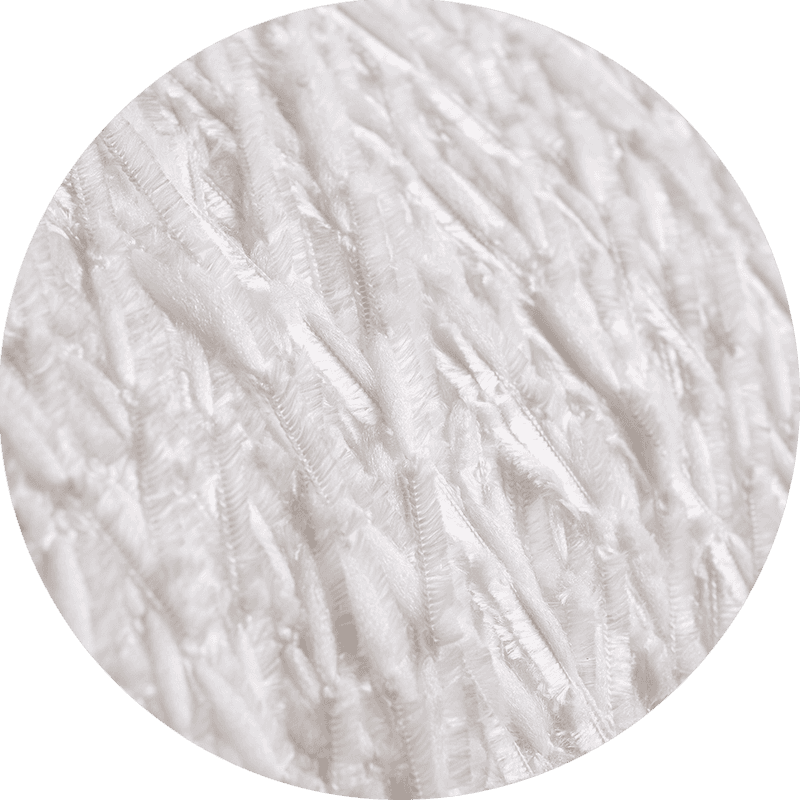
The textile industry classifies novelty yarns primarily by their structural feature — the specific form of irregularity or effect that distinguishes them from plain yarns. The following categories represent the most commercially significant types, each with distinct construction logic and design output.
Slub yarns contain deliberately introduced thick sections — called slubs — interspersed with thinner, more regular sections along the yarn length. In traditional ring spinning, slubs are created by intermittently reducing draft tension during the attenuation process, allowing more fiber to accumulate at specific points. Modern air-jet and rotor spinning systems can produce programmed slub patterns with computer-controlled variation intervals, enabling designers to specify slub length, frequency, and thickness ratio with precision. The resulting fabric has an irregular, subtly textured surface with visual depth that reads as handcrafted or linen-like, making slub yarns a staple in casual apparel, home textiles, and shirting fabrics where a natural, artisanal aesthetic is desired.
Loop yarns are produced by overfeeding an effect yarn relative to a core yarn during the twisting process, causing the surplus effect yarn to form projecting loops along the yarn surface. When the loops are tight and consistent, the yarn is described as a loop yarn; when the loops are more irregular in size and partially twisted back on themselves, the structure is called bouclé — from the French word for "buckled" or "curled." Bouclé yarns are among the most recognized novelty yarn categories in fashion, associated with structured woven and knitted fabrics used in coats, jackets, and suiting. The loop structure creates a fabric surface with significant visual complexity, a soft hand, and natural insulating pockets of trapped air within the loop structure.
Chenille — named after the French word for caterpillar — is produced through a specialized manufacturing process in which a pile fabric is woven and then cut into narrow strips, with the cut pile fibers projecting radially from a core of twisted binder yarns. The result is a yarn with a dense, soft, velvety pile surface that creates exceptionally soft fabrics with a characteristic light-catching sheen. Chenille is widely used in upholstery, home furnishing fabrics, robes, and decorative knitwear. Its primary structural limitation is the tendency of the pile fibers to shed or "worm" — rotate and expose bare sections of the core — under abrasion or repeated flexing, which is why chenille yarn specifications often include a binder yarn count and twist specification designed to minimize this behavior.
Knop yarns (also called nub or spot yarns) feature compact, localized concentrations of fiber wound tightly around the core yarn at intervals, creating a series of raised knots or spots along the yarn length. These knops can be produced in contrasting colors by using a different fiber or colored roving for the effect component, creating a yarn with periodic color accents that produce a spotted or flecked pattern in the finished fabric. Tweed fabrics and Harris Tweed in particular rely heavily on nub yarn structures to create the characteristic flecked surface that defines the fabric's visual identity. The knop structure is dimensionally stable and processes well on both weaving and circular knitting equipment.
Spiral yarns are constructed by twisting a soft, thick effect yarn around a finer, firmer core yarn in a consistent helical pattern, producing a yarn with a visible coiled surface texture. When the two component yarns differ significantly in count, the thicker yarn wraps completely around the thinner core, creating a corkscrew-like structure. Fabrics woven or knitted from spiral yarns have a pronounced ribbed or twisted surface relief that creates strong directional texture and significant three-dimensional visual depth. These yarns are used in statement knitwear, decorative scarves, and textured upholstery fabrics where surface drama is a key design objective.
Flake yarns incorporate small tufts or bundles of contrasting fiber — typically wool nepps, colored fiber fragments, or metallic filaments — at intervals along the yarn body, creating a speckled appearance in the finished fabric. Marl yarns (also called melange or heather yarns) are produced by twisting together two or more single yarns of different colors, creating a twisted two-tone or multi-tone effect that reads as a heathered or mottled color in woven or knitted cloth. Marl yarns are widely used in casual knitwear, sportswear fleece, and socks because the color blending achieves visual richness without the complexity and cost of yarn dyeing or printing processes.
Beyond structural type, novelty yarns are also classified by their fiber content, which determines the yarn's handle, durability, dyeing behavior, and end-use suitability. The structural effect and fiber composition interact significantly — the same loop structure in a mohair effect yarn produces a dramatically different handle and visual output than an identical loop structure in a polyester filament yarn.
| Fiber Type | Common Novelty Yarn Types | Key Design Advantage |
| Wool / Mohair | Bouclé, loop, slub, nub | Natural loft, warmth, halo effect on mohair loops |
| Cotton | Slub, marl, flake | Natural texture, breathability, washability |
| Acrylic / Polyester | Chenille, loop, spiral | Color vibrancy, dimensional stability, cost efficiency |
| Linen / Ramie | Slub, nub | Organic texture, cool hand, natural irregularity |
| Metallic filament | Wrapped, spiral, flake | Light reflection, decorative sparkle, evening wear appeal |
| Blended / Mixed | Bouclé, chenille, marl | Combined handle and performance properties |
The commercial case for novelty yarns rests on a set of specific functional and design advantages that plain yarns cannot replicate. Understanding these advantages in practical terms clarifies when and why novelty yarn specifications are justified despite their typically higher cost compared to commodity yarn types.
One of the most commercially significant advantages of novelty yarns is their ability to deliver complex surface aesthetics directly from the yarn structure, without requiring additional fabric-finishing processes such as printing, embossing, or embroidery. A fabric woven from bouclé yarn has inherent three-dimensional surface texture that would require mechanically embossed finishing or jacquard weaving complexity to approximate using plain yarns. A fabric knitted from slub cotton achieves a linen-like irregular texture that is difficult to replicate through yarn processing alone. This built-in visual complexity reduces the number of downstream production steps required to achieve a target aesthetic, which has direct cost and lead time benefits in fast-moving apparel and home textile production.
The handle properties of novelty yarns — the softness of chenille pile, the springy resilience of bouclé loops, the subtle irregularity of slub texture — create sensory experiences that consumers associate with quality, craftsmanship, and design intent. In a market where many mid-range garments are constructed from similar commodity fabrics, novelty yarn fabrics stand out at the point of touch in retail environments, creating a tactile premium that supports higher price positioning without requiring more expensive fiber inputs. A polyester chenille fabric, for example, can achieve a perceived luxury hand at a fraction of the cost of a cashmere fabric, making novelty yarn construction a practical tool for accessible luxury positioning.
Several novelty yarn types provide genuine functional thermal advantages that derive directly from their structural geometry rather than from fiber insulation properties alone. Loop and bouclé yarns trap air within the enclosed spaces of their loop structures, adding an insulation increment to fabrics constructed from them. Chenille yarns create a dense pile surface with air pockets between the pile fibers, providing warmth that significantly exceeds what a flat-surface yarn of equivalent weight would deliver. Slub yarns produce fabric surfaces with alternating dense and light areas that create localized air pockets at the slub positions. These structural insulation effects are particularly valuable in home textile applications — throws, blankets, cushion covers — where warmth-to-weight ratio is a key consumer driver.
Novelty yarns provide color expression capabilities that flat single-color yarns cannot match. Marl and melange yarns create heathered color effects from two or more twisted color components, producing a visual depth and richness in solid-color garments that reads as more complex and interesting than a truly uniform color. Nub and flake yarns introduce periodic color accents that create pattern without requiring multi-color yarn feeding or jacquard programming. Space-dyed novelty yarns — where different sections of the yarn are dyed in different colors before construction — produce unpredictable, organic color patterning in knitted and woven fabrics that is genuinely unique in each piece. These color variation capabilities are particularly valuable in hand-knitting yarn markets, where color complexity and uniqueness are primary purchase drivers.
From a commercial design protection perspective, fabrics constructed from proprietary novelty yarn specifications are more difficult to copy exactly than fabrics woven or knitted from standard commodity yarns. The specific combination of loop size, slub interval, nub color, and fiber composition that defines a particular novelty yarn creates a fabric signature that is hard to replicate precisely without access to the same yarn construction specification. Fashion brands and home textile companies increasingly use proprietary novelty yarn development as a product differentiation strategy that offers some practical protection against fast-fashion copying, even in the absence of formal design registration.
The structural irregularities that make novelty yarns visually and tactilely distinctive also create specific challenges in fabric manufacturing that need to be managed proactively.
The breadth of novelty yarn classification — from slub cottons used in fast-fashion shirting to precision-engineered metallic bouclés used in luxury suiting — reflects the versatility of the underlying structural engineering principles. Each type translates a specific construction method into a distinct set of visual, tactile, and functional advantages that serve clearly defined market needs. Matching the right novelty yarn classification to a specific design application remains one of the most value-generating decisions available to textile designers and product developers working across apparel, home textiles, and technical fabric categories.



Copyright © Tongxiang Xinsili Textile Co., Ltd. All Rights Reserved. Wholesale High Filament DTY Yarn Manufacturers
